The Personal Finance Advice That Makes White Women Financially Free Will Keep You Broke. Here's Why
Standard personal finance advice isn’t a one-size-fits-all. The mainstream wealth-building strategies that pave the way to financial freedom for some often completely ignore the systemic barriers, cultural nuances, and unique economic realities faced by women of color. This editorial breaks down exactly why traditional money rules might be keeping you broke and how to build a financial strategy that actually works for your reality.
5/17/2026

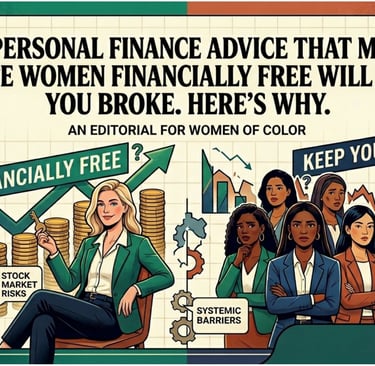
You have read the books. You have followed the influencers. You have downloaded the budget templates and color-coded your spending categories. Yet, despite doing everything the personal finance gurus told you to do, the finish line still feels impossibly far away. You are not imagining it, and neither are you failing. Most of the personal finance advice that floods our timelines, bestseller lists, and podcast feeds was designed with a very specific woman in mind: white, middle-class, and operating in a financial system that was built to work for her. Therefore, for women of color, following that same roadmap is ineffective; it can actively keep you broke, burn you out, and keep you wondering what is wrong with you. This article will show you that nothing is wrong with you. The map is wrong.
The Wealth Gap Is Not a Mindset Gap
The most dangerous myth in mainstream personal finance is that wealth is purely the result of discipline, mindset, and good habits. "Spend less than you earn." "Cut the lattes." "Invest early and often." Sound advice in a vacuum, but the thing is, the vacuum does not exist.
According to data from the Federal Reserve's Survey of Consumer Finances, in the United States, the median white family holds about $188,200 in wealth, while the median Black family holds just $24,100, which is a ratio of nearly 8:1. No amount of frugality can close that gap on its own. The wealth gap is a structural gap rooted in decades of discriminatory housing policy, predatory lending, and compounding generational disadvantage.
When a white financial influencer tells you she built her emergency fund by "cutting subscriptions and eating at home," she may be leaving out a few things: a family safety net, an inheritance, no student loans, or a partner whose income provided stability while she "hustle-saved". This is not a judgment; it is just providing context. And context is everything.
The "Invest Early" Advice Ignores Your Starting Line
One of the most repeated pieces of financial advice is: “start investing at 25 and retire rich”. The math checks out, in theory, that is. Example: If you invest $300/month starting at age 25 at a 7% average annual return, by age 65, you would have approximately $791,000. This is in theory; here is the reality for many women of color living in the United States: the median student loan debt for Black women is among the highest of any demographic group. According to the American Association of University Women (AAUW), Black women borrow more and earn less after graduation due to the intersection of the racial pay gap and the gender pay gap. Black women are typically paid 67 cents for every dollar earned by a white, non-Hispanic male.
If your $300/month is already going to a student loan, a family member who needs help, or the higher cost of living, where does the opportunity exist to "invest early"? There is nothing wrong with the advice; the problem is the starting conditions.
The "Family Tax" Is Real, but It's Not Discussed
Mainstream personal finance rarely discusses what many women of color know as the "family tax" which is the financial responsibility that often falls on first-generation earners to support extended family members. This includes:
Sending $200–$500/month to parents or siblings
Covering funeral costs, medical bills, or school fees for relatives
Being the financial backstop when things go wrong in your family
This isn't irresponsibility. It is community. It is love. But it is also a financial reality that is never addressed on financial freedom shows. If you are carrying this weight, you need a financial strategy that accounts for it, not one that shames you for it.
What Actually Works for Women of Color: A Reworked Framework
Here's a framework that acknowledges your real life:
1. Calculate your real net income. This is calculated after taxes, loan repayments, and regular family contributions.
2. Protect yourself first (yes, really). Even $500–$1,000 in a separate account as a starter emergency fund changes your psychological relationship with money.
3. Attack high-interest debt aggressively. Credit cards at 20–29% interest are a financial emergency. A $3,000 credit card balance at 24% APR costs you roughly $720/year in interest alone if you only make minimum payments.
4. Invest in income-producing skills, not just the stock market. Negotiation skills, certifications, and side income streams can produce returns faster than index funds when you are starting from behind.
5. Build your net worth in a community. Group economics, rotating savings, credit associations and community investment are not "backwards"; they are time-tested and culturally relevant.
The Home Ownership Trap
White financial culture has long celebrated homeownership as the cornerstone of wealth-building. But for colored families, this path has historically been a minefield; from being steered toward subprime mortgages to being denied loans at higher rates than their white counterparts with similar credit profiles.
Buying a home in a neighborhood undergoing intense redevelopment can grow your equity, but it can also trap you if the market prices fall, taxes rise, and your income doesn’t keep pace. The point is not to avoid homeownership, but it is to go in with eyes open, not just following a script written for someone else's history.
The personal finance industrial complex was not built with people of color in mind, but that does not mean you cannot build wealth. It means you need a strategy that is honest about where you are starting, who you are responsible for, and what the system actually costs you. Financial freedom for women of color requires more than cutting costs. It requires raising income, advocating for equal pay, building community wealth, and making peace with the fact that your journey will look different because your starting point is different. That is not a disadvantage you need to apologize for; it is a reality you need to plan around. The goal is not to follow the same map to a different destination; it is to draw a new one. You are not behind. You are building under different conditions. And when you make it — and you will — you will bring others with you. That is not just financial freedom. That is legacy.
Have you ever followed mainstream financial advice and felt like it just didn't apply to your life? What was it?
Take the Free Financial Freedom Stage Assessment and begin your journey to financial freedom.
The following resources were used in preparing this article:
Federal Reserve. Survey of Consumer Finances. https://www.federalreserve.gov/publications/files/scf23.pdf
AAUW. Deeper in Debt: Women and Student Loans. https://www.aauw.org/resources/research/deeper-in-debt/
National Women's Law Center. Wage Gap Data. https://nwlc.org/resource/the-wage-gap-the-who-how-why-and-what-to-do/
Brookings Institution. Examining the Black-White Wealth Gap. https://www.brookings.edu/articles/examining-the-black-white-wealth-gap/
Consumer Financial Protection Bureau. Mortgage Lending Discrimination. https://www.consumerfinance.gov/consumer-tools/mortgages/answers/key-terms/
Insider. "Family Tax" and the Black Middle Class. https://www.businessinsider.com/black-middle-class-family-tax-wealth-gap
Pew Research Center. Racial Wealth Inequality. https://www.pewresearch.org/social-trends/2017/11/01/trends-in-income-and-wealth-inequality/